The CAGED System Explained (Simple, Visual, and Perfect for Country & Bluegrass)
If you’ve ever watched a great country or bluegrass guitarist and wondered:
“How do they know where to play on the neck?”
The answer is often the CAGED system.
The CAGED system isn’t complicated theory. It’s a fretboard map built from chord shapes you already know, showing you where chords, fills, and lead notes live all over the neck.
Let’s break it down in the clearest way possible.
Quick note: This fretboard “map” is the same kind of thinking we use at Country Guitar Online—not as dry theory, but as the logic behind real fills, licks, and pentatonic-based lead playing.
Want step-by-step help applying this to real country & bluegrass playing? Start here →
What Does “CAGED” Mean?
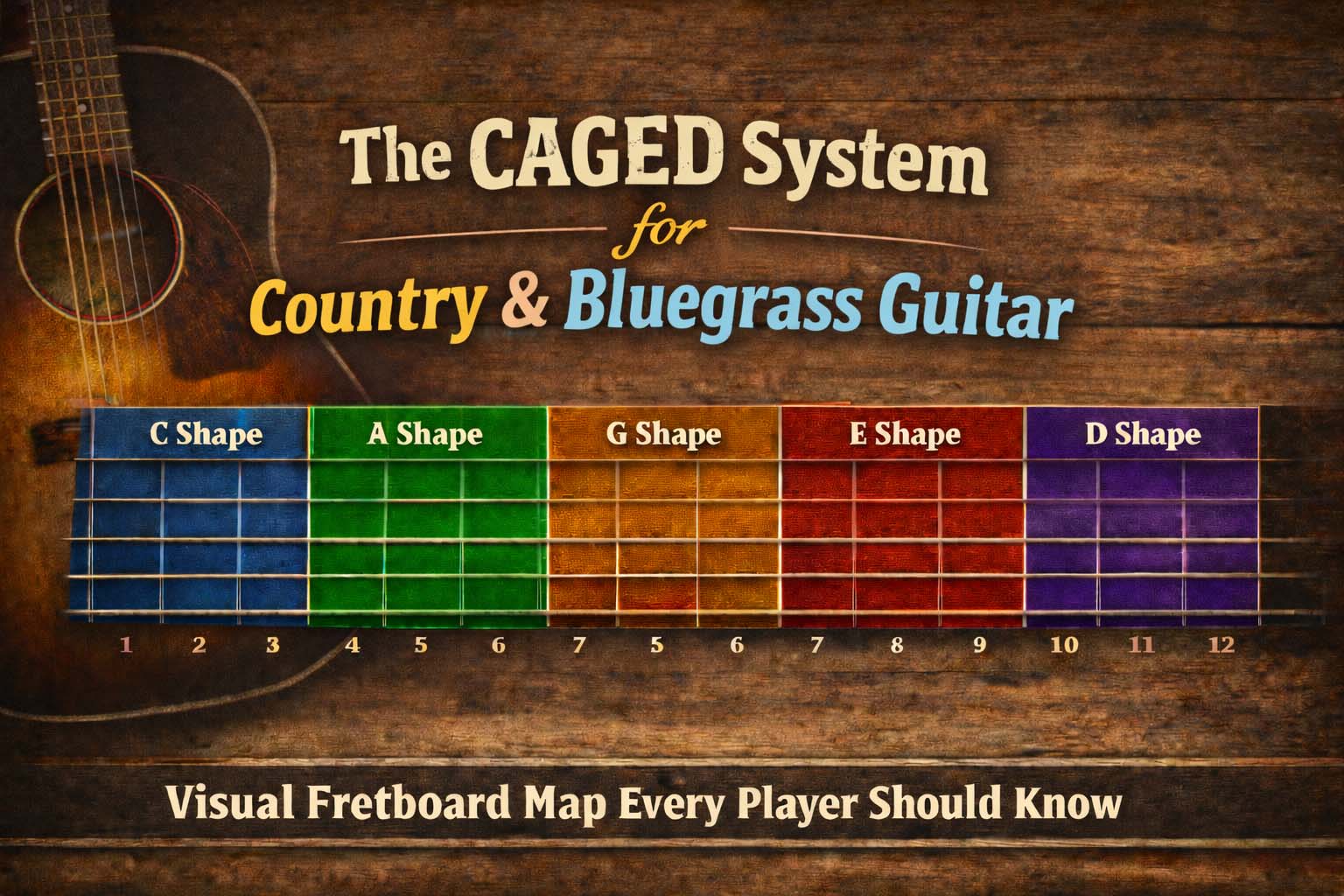
CAGED comes from five open chord shapes:
- C
- A
- G
- E
- D
These five shapes:
- Repeat up and down the neck
- Connect seamlessly
- Cover the entire fretboard
Once you see how they link together, the neck stops feeling random.
The CAGED System — Shown Visually
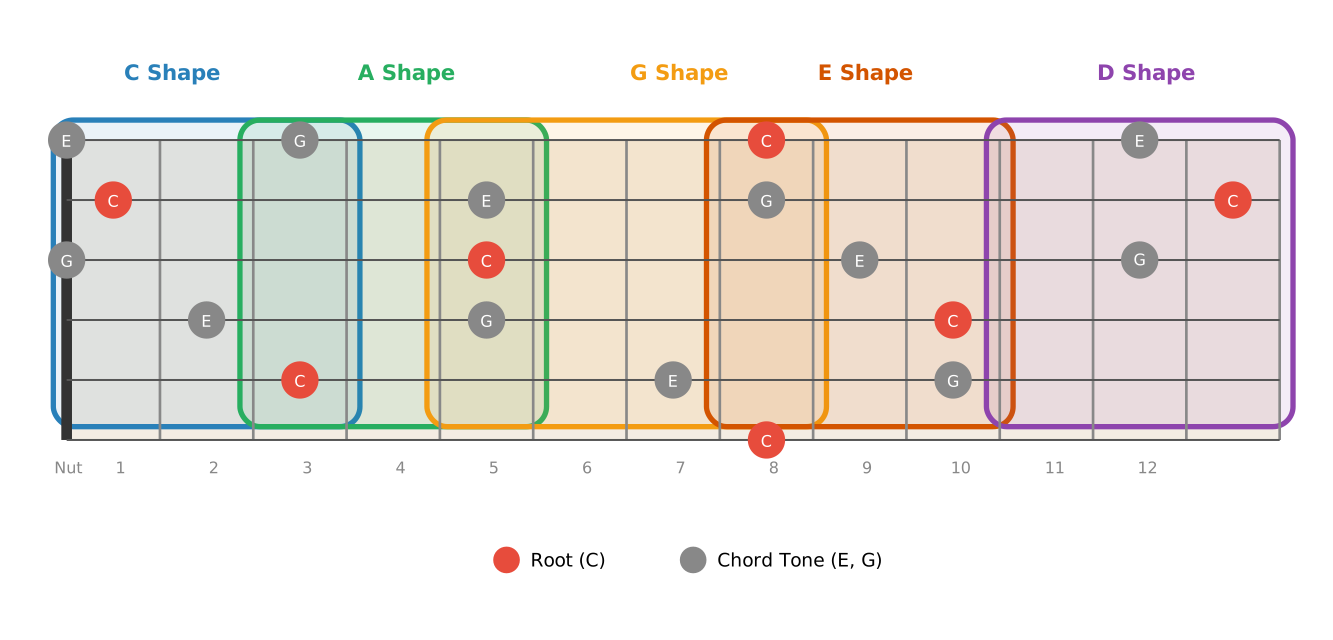
Below is a CAGED system map in the key of C.
Important:
- Five shapes span across the neck (C-A-G-E-D)
- Each shape in this diagram is a C chord when played
- This diagram shows C as the root
- The red dots are C notes (root notes)
- The gray dots are chord tones (E and G)
- The shapes stay the same in every key
- Only the root-note dots change when you change keys
CAGED System – Key of C (Root = C)
How to Read This Diagram
1. The Colored Boxes Are the CAGED Shapes
Each colored overlay represents one CAGED position:
- Blue = C shape
- Green = A shape
- Orange = G shape
- Red = E shape
- Purple = D shape
Notice how they overlap and connect. That’s the entire CAGED system.
2. The Root Notes Are the Key
The red dots show every C note inside each shape.
Those notes are:
- The root of the chord
- The safest notes to land on
- The notes that make fills and solos sound right
When you change keys:
- The shapes stay the same
- The root notes move
Key of C = C is the root
Key of G = G becomes the root
Key of A = A becomes the root
This is where most players get stuck: seeing the map is step one. Learning how to use it for real country & bluegrass fills is step two.
That’s why CGO focuses on practical lessons built around:
- pentatonic-based fills that fit the chord
- landing on chord tones at the right time
- connecting positions so the neck feels “joined up”
How This Relates to Pentatonic Shapes
If you already know pentatonic positions, you’re closer to CAGED than you think.
Pentatonic shapes sit inside these CAGED chord positions.
The CAGED system simply shows:
- Where the chord tones are inside the scale
- Why certain notes sound stronger than others
- How to move between positions musically
This is why pentatonic-based playing works so well in country and bluegrass.
Why This Is Perfect for Country Guitar
Country guitar is all about:
- Playing around the chord
- Adding fills between lyrics
- Sliding into strong notes
This diagram lets you see the chord under your fingers so you’re aiming at musical notes — not guessing.
How Bluegrass Players Use the Same Map
Bluegrass players use the same shapes, but with:
- Faster tempos
- More single-note lines
- Strong chord-tone targeting
Most bluegrass leads are simply chord tones plus motion. This map shows you exactly where those tones are.
In this context, “motion” means the notes that connect chord tones and make the line move forward instead of sounding static.
More specifically, motion can include:
- Passing tones – notes between chord tones
- Slides, hammer-ons, and pull-offs
- Scale runs leading into or out of chord tones
- Approach notes (a half-step or whole-step above or below a chord tone)
- Rhythmic movement — changing note lengths or syncopation
So when people say:
Chord tones + motion
They mean:
- Chord tones give you the right notes
- Motion gives you the feel, direction, and drive
In bluegrass especially, motion is what turns a chord into a melodic lead line instead of just an outline of the harmony.
This is also the foundation of how we teach lead guitar at Country Guitar Online. Instead of memorizing random licks, you learn how to target strong notes (chord tones) and connect them with motion—using practical, pentatonic-based fills and real musical examples.
Best Practice Tip
Don’t try to memorize everything at once.
- Pick one shape
- Play the chord
- Find the root notes
- Add simple fills
- Slide into the next shape
This is how the fretboard starts making sense fast.
Final Thoughts
The CAGED system isn’t about playing more notes.
It’s about knowing where you are, knowing where you’re going, and playing with confidence — exactly what great country and bluegrass guitar requires.
Want to Go Deeper?
If this diagram helped the fretboard click, the next step is learning how to use it in real playing.
At Country Guitar Online, we focus on lessons that help you:
- Play country & bluegrass fills that outline the chord
- Use pentatonic positions with better note targeting
- Connect ideas across the neck without guessing
That’s the difference between understanding the map and actually traveling it.